
THE question
23/09/2026
Do you need to know how to cook an egg to open a restaurant?
This is THE question you have never asked yourself. Yet, it touches on a real issue: we tend to think that starting a business requires expertise in the specific field involved. However, many serial entrepreneurs launch into vastly different projects one after another. Should you build a business based on your existing expertise, or do you need the expertise of entrepreneurship itself?
Picture the scene: an entrepreneur walks into the kitchen of the restaurant they have just opened. Around them, pans are heating up, orders are piling in, and plates are making their way out to the dining room.
The only problem? They don’t know how to cook an egg.
The situation may seem absurd, but it sums up a question I have often asked myself. I launched ventures in sectors with little in common: fintech (B2B SaaS) with Soan, culture with Youboox (the “Spotify of reading”), and then sports with Leikar. I wasn’t an expert in any of these industries when I entered them. Yet that didn’t stop me from identifying real problems, building teams, and making business models work.

So, do you necessarily have to be an expert in the field you are venturing into?
I don’t think so.
Expertise: an open mind
A lack of expertise can sometimes even be an advantage. Experts know their sector –its rules, constraints, and history– inside out. But they also know all the reasons why an idea won’t work. Someone new to an industry may ask naive yet essential questions: Why is it done this way? Why hasn’t anyone tried doing it differently?
Expertise, then, isn’t the problem; certainty is what can become one.
This question is even more relevant today, now that information is abundant and instantly accessible. Technologies are evolving rapidly, industry boundaries are blurring, and artificial intelligence is further accelerating access to knowledge.
In this context, value lies less in knowing everything than in the ability to learn quickly, ask the right questions, and surround oneself with the right people.
Of course, knowing nothing is not a strategy. An entrepreneur needs to understand their market well enough to recognize competence and make sound decisions.
But they don’t need to be the person who cooks the egg best.
They need to find the person who does it better than anyone else, give them the means to succeed, and build a solid company around their talent.
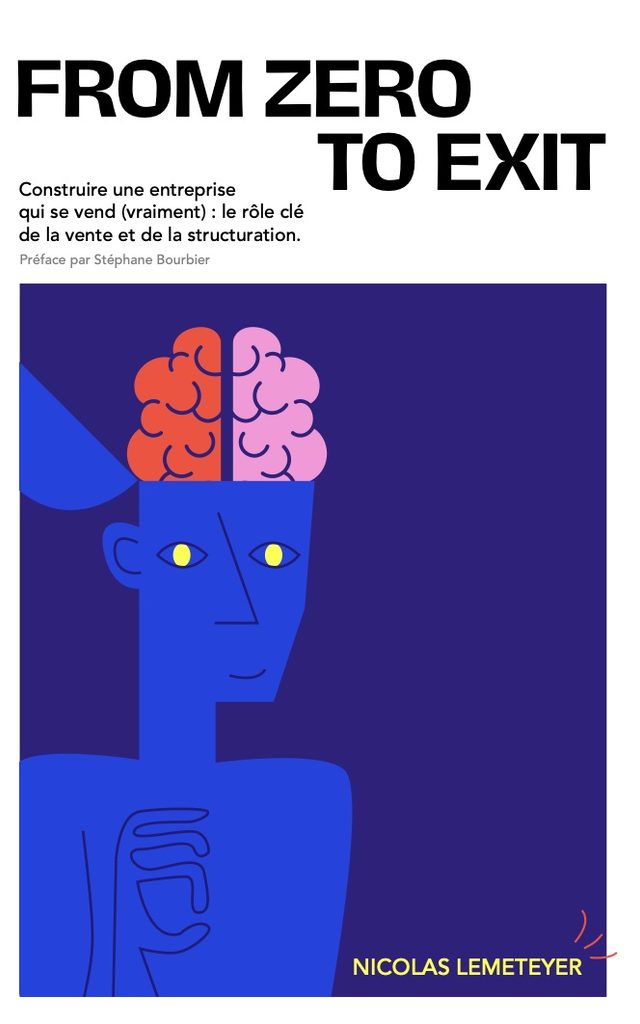
From Zero to Exit: Building a Company That (Really) Sells—The Key Role of Sales and Structuring, by Nicolas Lemeteyer
What kept me committed to my various projects was never just the product. It was the pleasure of building, structuring a team, and gradually seeing a business model come together. I think many entrepreneurs are passionate by nature, passionate about the process itself rather than any specific sector. But passion alone burns out quickly and doesn’t pay the salaries at the end of the month. It takes discipline, adaptability, and a great deal of sacrifice.
Almost everything will take twice as long and be twice as hard as expected. Many will think your project is fantastic, yet you will spend your days hearing “no.”
Cooking an egg can be learned quickly. Learning how to sell, build a team, make decisions, and get others on board takes far longer. And perhaps that, ultimately, is the true expertise of an entrepreneur. You also need to know how to sell, adapt, and keep going despite rejection.
Cooking an egg can be learned quickly. The discipline to execute and the ability to manage human relationships takes a bit more.
To further explore this topic, I invite you to read these three texts from SKEMA Knowledge:
- “Effectuation: how to visualise your hidden resources” (link below) shows how an entrepreneur can move forward amidst uncertainty by leveraging their skills, experience, and network.
- “Sailing in the Dark: the Vendée Globe as an Allegory for Entrepreneurship” (link below) reminds us that entrepreneurship is less about following a perfectly mapped-out route and more about continuously adjusting one’s course.
- Finally, “The More AI Thinks, the More Leadership Matters” (link below) explains why –as information and analysis become abundant– judgment, decision-making, and the ability to mobilize others become even more valuable.
Go further
Does this topic interest you?
We recommend reading these articles:

To turn each challenge into strategic opportunities

Another approach to uncertainty
The More AI Thinks, the More Leadership Matters
Abundant analysis, scarce judgment