The American prison system, or the business of incarceration






How did incarceration become a market? From private prisons to prison labor, the American prison system reveals the rise of a powerful economy of incarceration. An analysis of a controversial model where criminal justice, profit incentives, and public policy intersect.
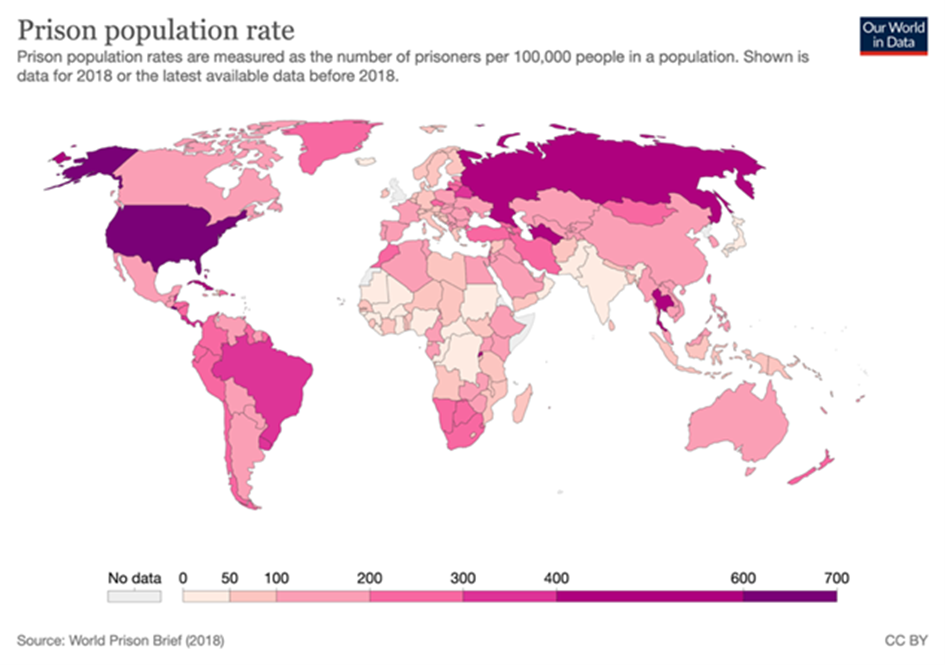
The United States has the highest incarceration rate in the world with 655 prisoners per 100,000 inhabitants – almost six times more than China – and accounts for a quarter of the world’s prison population. Could the Land of the Free also be a land of deprivation of liberty ? No doubt, but it is also a land of business interests, with half of the prison population working while incarcerated, sometimes for the private sector. This business generates several billion dollars in profits each year…
The virtues of prison labour, from Tocqueville to the present day
In the 1830s, Alexis de Tocqueville and Gustave de Beaumont were commissioned by the French government to write a report on the American penitentiary system. According to them, the ideal model was one that “reconcilied the moral reform of prisonners with economy in expenditure”. The American system then combined these two imperatives by making prisoners work, which on the one hand reduced costs and on the other prevented idleness, the mother of all vices. In a letter addressed to his father in 1831, Tocqueville wrote: ‘The American system is more economical than ours.’ Even today, many American public figures, most often close to the Republican Party, advocate prison labour. One such proponent, Heather Mac Donald, explains that a system of prisoner labour reduces some of the cost of incarceration (80 billion dollars in 2019).
The prison system, a market like any other?
This argument is somewhat misleading. The revenue generated by prison labour in public institutions is largely used to finance government services other than the judicial or prison system. Prisoners have, for example, been used as labour to clean up the devastation caused by Hurricane Katrina, or as firefighters supporting officialforces during episodes of wildfires. Most prisoners work while incarcerated if their physical condition allows it and they aren’t considered too dangerous. The majority are assigned to collective tasks that directly serve the prison in which they are held, known as prison work assignments. However, around 7% of the total prison population work in industries, known as prison industry programmes, trhough organisations such as UNICOR, which operates under the Department of Justice and makes federal prison inmates available to private companies. This situation benefits many multinational corporations, including McDonald’s, Walmart, Victoria’s Secret and Starbucks.
‘I cannot go on strike, nor can I unionize. I am not covered by workers’ compensation of the Fair Labor Standards Act. I agree to work late-night and weekend shifts. I do just what I am told, no matter what it is. I am hired and fired at will, and I am not even paid minimum wage: I earn one dollar a month. I cannot even voice grievances or complaints, except at the risk of incurring arbitrary discipline or some covert retaliation.
You need not worry about NAFTA or your jobs going to Mexico and other Third-World countries. I will have at least five percent of your jobs by the end of this decade.
I am called prison labor . I am The New American Worker.”
Statement by Michael Lamar Powell, incarcerated at Capshaw prison, Alabama.
A distinctive feature of the United States is that the management of prisons is either entrusted to public authorities or outsourced to private companies. While this dual system of management is not new, the privatisation of penitentiary establishments saw a significant increase starting the Reagan administration. Even though private facilities hold only 8.5% of prisoners, their rate of growth is far higher than that of public facilities, particularly those run by individual states.
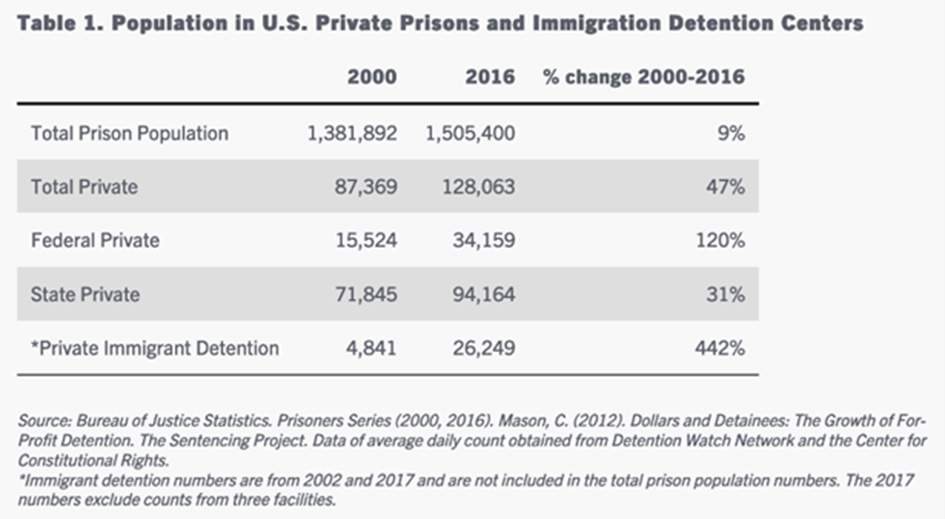
Today, two major companies, the Corrections Corporation of America (CCA)and the GEO Group, share this huge market. In 2012, for example, CCA offered to buy the publicly run prisons of 48 states. In 20 years, CCA’s turnover increased by more than 500%. What explains private corporations’ appetite for this sector? The answer is simple: prisons represent a genuine financial windfall, with wages averaging less than one dollar an hour. In some southern states, such as Alabama or Texas, prison labour is not paid at all. Under these conditions, it is easy to understand why these companies negotiate contractual minimum occupancy rates of between 80 and 100% and actively lobby in favour of prison sentences, a practice that raises serious ethical concerns. When crime rates fall, it is not uncommon for public state-run prisons to operate below capacity because prisoners are sent to private facilities as a priority. Have prisons become production sites like any other? How can these practices that appear so contrary to American ideals, steeped in Enlightenment philosophy, be explained
Prison in the United States, a reflection of American political philosophy and history
To understand how the prison system works, it is necessary to return to the origins of American democracy. James Whitman, Professor of Law at Yale, argues that the process of democratisation unfolded very differently in Europe and in the United States. According to him, European societies democratised through a process of ‘levelling up’, that is, by extending to all the right to expect forms of treatment once reserved for those on the highest rung of the social hierarchy. In other words, in Europe, where once there were aristocrats, all are aristocrats now. The United States, he argues, followed the opposite model, based on a form of egalitarianism that levels down: there are no longer any aristocrats, and everyone shares the bottom rung of the social ladder. This would explain why European law considers that prisoners are deprived of liberty but not of equality nor fraternity, whereas American prisoners are treated without any regard. In some respects, they are treated as people were under the Ancien Régime. Whitman sees this as the origin of the harsh treatment of prisoners under American law and does not hesitate to describe prison as a place where individuals are deliberately degraded. The working conditions imposed on prisoners, their very low wages, and the absence of social rights are merely the concrete expression of this logic. This stands in striking contrast with Germany, for example, where working prisoners enjoy social rights and paid leave.
There is, however, another factor that helps explain both the high incarceration rates and the near-systematic use of forced labour: namely the conditions under which the United States brought slavery to an end. The 13th Amendment to the United States Constitution, which abolished it in 1865, nevertheless allows slavery or involuntary servitude as punishment for criminal convictions.
Neither slavery nor involuntary servitude, except as a punishment for crime whereof the party shall have been duly convicted, shall exist within the United States…
In other words, the very provision that formally abolishes slavery authorises an exception. This, in part, explains the treatment of prisoners and the fact that they are not considered ‘employees’ or ‘workers’ in the commonly understood sense.
Moreover, the abolition of slavery had another indirect effect, depriving the southern states, including Alabama and Mississippi, of a workforce of four million people. According to the academic Melissa Rubio, the justice system was then used to fill this gap through forced labour. In the decades that followed, these same states adopted Black Codes that allowed them to imprison Black people on the mere grounds of ‘vagrancy’, a charge that could be brought against anyone found guilty of theft, drunkenness, neglect of family or professional duties, or behaviour deemed provocative or disorderly. In other words, as underscored by Melissa Rubio, it is no exaggeration to say that part of the Black American population moved from plantations to prisons. With figures to support her claims, she estimates that counties that practised slavery prior to 1865 deliberately incarcerated more Black Americans than other counties, to secure a servile workforce. The result is that, to this day, African Americans make up just 13% of the population of the United States, but account for 40% of the prison population. In total, 1.5% of Black American citizens are in prison, compared with 0.3% of white citizens…
To conclude, Tocqueville, a keen observer of the American prison model, identified in his day both the system’s economic benefits and its social costs. While it is clear today that running prisons can prove profitable for private operators, does it actually reduce crime and prevent reoffending? This is a complex issue we will revisit in a later article.