Middle East: regional crisis, global disorder

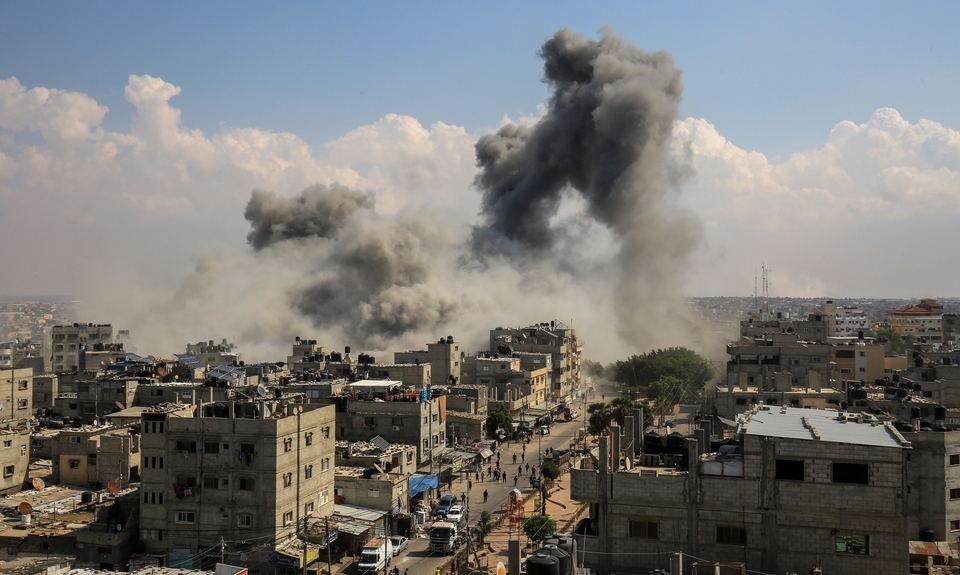
Each month, Frédéric Munier, Director of the School of Geopolitics for Business at SKEMA Business School, publishes a column in the magazine Pour l’Éco. The geopolitical sequence of events engulfing Israel and the Gaza Strip since 7 October is upsetting the various states of balance that had previously prevailed in the Middle East. What will this lead to in regional and global terms?
In his book Le Prophète et la pandémie (The Prophet and the Pandemic), published in 2021, Gilles Kepel described the recent recomposition processes at work in the Middle East. In particular, he contrasted what he called the “brotherhood-Shiite axis” (i.e. an alliance between the Sunni Muslim Brotherhood and Shiite Muslims) involving Turkey, Qatar and Iran with the “Abrahamic entente” between the United Arab Emirates, Bahrain, Sudan, Morocco and Israel.
The Axis and the Entente
The glue holding the “axis” together is opposition to Israel and the promotion of political, even terrorist, Islamism, as demonstrated by its support for both Hamas and Hezbollah. Meanwhile, the “entente” links Muslim countries that have opted for realpolitik, in whose name they recognised Israel under the Abraham Accords signed in 2020. The use of expressions dating back to the start of World War I is significant. This surprising re-shaping of alliances stems from several factors, including the United States’ partial withdrawal from the Middle East and the rise of regional giants.
Turkey, for example, has developed a “neo-Ottoman” policy based on interventionism in Libya, Syria and the eastern Mediterranean. Saudi Arabia, for its part, while maintaining a special relationship with the US dating back to the Quincy Pact of 1945, is now conducting an increasingly autonomous diplomacy, as witness its spectacular rapprochement with Iran (March 2023) under Beijing’s aegis.
Middle East, extreme views
As witness, too, the fact that it was very likely poised to join the Abraham Accords and recognise Israel, thereby sacrificing the Palestinian cause on the altar of realism. But the appalling images of the Hamas attack on 7 October and Israel’s reaction in the Gaza Strip has undermined this rapprochement between the Iranians and the Saudis. In the eyes of the Arab world, Saudi Arabia cannot afford to appear to condone the bombing of Gaza.
Read also: Cooperation or competition? China’s great divide
For the moment, the big winners in this tragic episode are undoubtedly Iran – which feared being weakened by an agreement between the Sunni countries and the Jewish state – and Russia, which is using the war in Gaza to distract people from the war in Ukraine. Beyond that, this crisis is causing global repercussions by contributing to an ever-widening gap between a “West” that supports Israel and a “Rest of the world” that upholds the Palestinian cause – not without ulterior motives.
It is also jeopardising the balance between Western countries, where public opinion is increasingly polarised over the issue. To quote Bertrand Badie, professor at Sciences Po, “it may not have been the centre of the world […], but the Middle East has never ceased to be at the centre of its agenda”.
This article was originally published in French in Pour l’Eco.