OpenAI’s Napoleon-Style Strategy

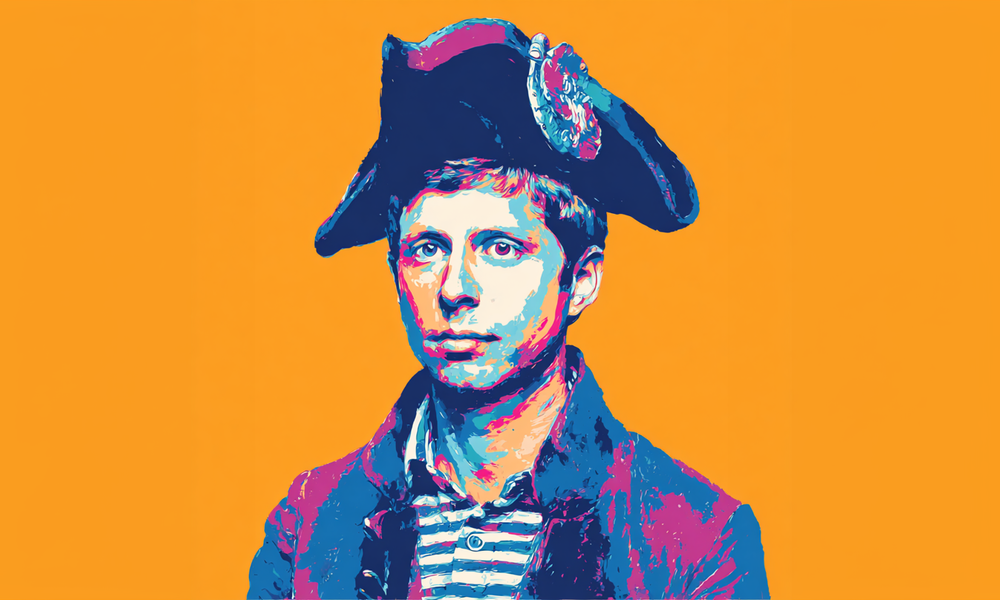
What if OpenAI had conquered the world thanks to Napoleon? The similarities between the strategy deployed by the AI giant and that of the 19th-century French emperor are striking.
The success of OpenAI represents one of the most rapid and disruptive corporate ascensions in modern technological history. Its flagship product, ChatGPT, became the fastest-growing consumer application ever, achieving mass adoption in a matter of months and solidifying the company’s brand as the face of the generative AI revolution. From its roots as a non-profit lab, OpenAI has rapidly become an industry powerhouse, securing billions in funding and fundamentally redefining the competitive landscape of the $13+ trillion global tech industry.
Read also: Did Oracle Crack the Leadership Code?
To fully understand how this resilient firm executed such a dominant strategic move, we apply The Four Stages of Competitive Endurance, a framework introduced in my book, The Timeless Principles of Successful Business Strategy (Springer). This model outlines the calculated progression resilient firms follow to not just survive, but to systematically outlast rivals, built upon the concept of rational audacity : blending boldness in execution with prudence in planning. OpenAI’s journey provides a compelling modern case study for the first three stages of this framework: Strategic Avoidance, Flank Attack, and Concentration of Effort.
Phase 1: Strategic Avoidance (2015–2019)
The initial stage for any enduring firm is Strategic Avoidance, characterized by deliberate evasion of direct confrontation with dominant market leaders. This time is used for building strength in the shadows. OpenAI perfectly executed this stage by founding itself as a non-profit research lab with a mission to ensure Artificial General Intelligence (AGI) benefits all humanity. This positioning was a masterstroke of strategic clarity: it avoided being perceived as a direct commercial threat, thereby neutralizing the incentive for giants like Google to launch aggressive counterattacks. The non-profit status was instrumental in attracting and concentrating world-class talent, appealing to researchers who might have been skeptical of pure corporate AI work. This phase established a culture focused on the AGI mission, rapid iteration, and the unique blend of academic ambition and product aggression.
Phase 2: Flank Attack (2019–2022)
As the firm gains capabilities, the strategy shifts to the Flank Attack, exploiting the structural and ideological weak points of the incumbents, following the Napoleonic principle of avoiding a frontal assault if an indirect one is possible. OpenAI’s strategic pivot involved two major flank maneuvers. The first was the launch of the GPT-3 API in June 2020, an attack through the undefended flank of developer APIs and creative applications. While incumbents focused on Search and Enterprise AI, OpenAI democratized access to its models, generating revenue, expanding data feedback loops, and positioning itself as the generative AI innovator without triggering a full-scale war. The second was the creation of a “capped for-profit” subsidiary in 2019—a flank maneuver in capital strategy that secured billions for expensive AI training while maintaining a mission-first ethos. This led to a crucial alliance with Microsoft, turning a potential competitor into a vital partner and solving the enormous capital and computing bottleneck by gaining access to Azure infrastructure.
Phase 3: Frontal Attack: the Concentration of Effort (Late 2022–2023)
Once a strategic advantage is established, the firm moves to the decisive Concentration of Effort, which often manifests as a Frontal Attack. The launch of ChatGPT in November 2022 was this decisive assault, aimed squarely at the mass consumer market that giants had left vulnerable. By packaging the powerful GPT model into a simple chat interface, OpenAI created the global “AI moment” and demonstrated perfect rational audacity: bold enough to release an imperfect product publicly, but prudent enough to iterate and learn quickly from massive user feedback. This move successfully exploited the incumbent’s dilemma, as rivals with superior resources were paralyzed by fears of cannibalizing search revenue and regulatory scrutiny. The viral success of ChatGPT created powerful First-Mover and network effects, rapidly leading to Ecosystem Lock-in and significant switching costs for developers and enterprises building on their API. While the brief ouster and reinstatement of CEO Sam Altman in November 2023 tested the organizational resilience, it ultimately affirmed the primacy of the audacious, growth-oriented strategy in the face of the decisive market assault.
The Unfinished War
OpenAI’s masterful execution of Strategic Avoidance, the Flank Attack, and the Concentration of Effort delivered a historic market advantage. However, as the analysis of The Four Stages of Competitive Endurance framework suggests, success in Phase 3 is not the final victory.
The final stage is Phase 4: Dominance. In this phase, the firm shifts from fighting for the system to controlling the system. True dominance is characterized by establishing a critical size that suffocates smaller challengers, neutralizing major rivals (either through takeover or strategic confinement), and actively shaping the environment by influencing industry standards and regulatory norms to raise barriers. The goal is to structure the market so that destructive competitive wars never need to be fought.
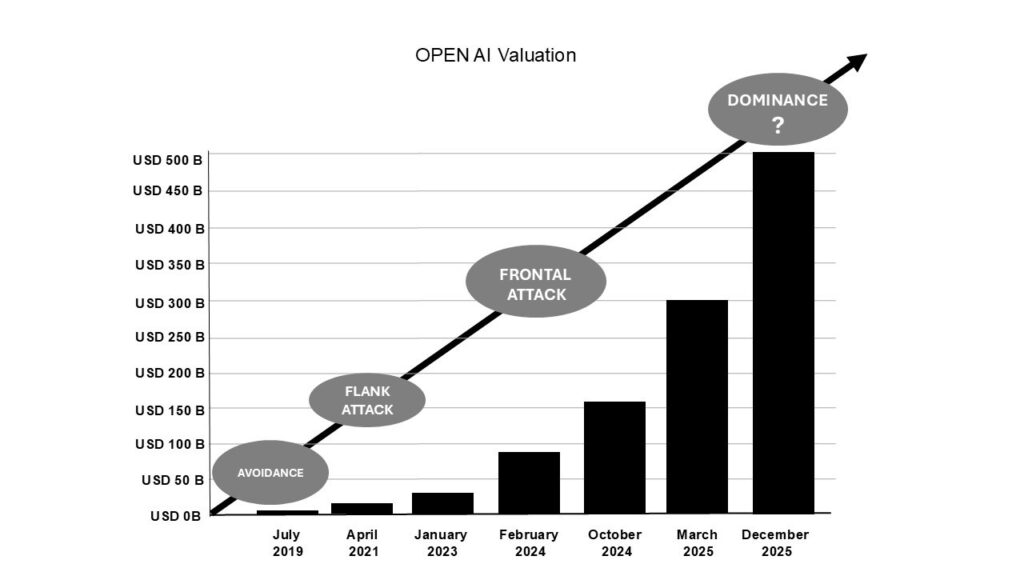
OpenAI is now in a precarious strategic limbo: it is dominant in narrative but not in consolidation. The firm finds itself suspended between the Frontal Attack (Phase 3) and the ultimate goal of achieving the system control defined by Phase 4. It won the battle for generative AI’s initial mindshare, but the war for market control is far from over.
The critical question is whether OpenAI can secure the final stage of Dominance before the market factors that facilitated its rise begin to actively undermine it.