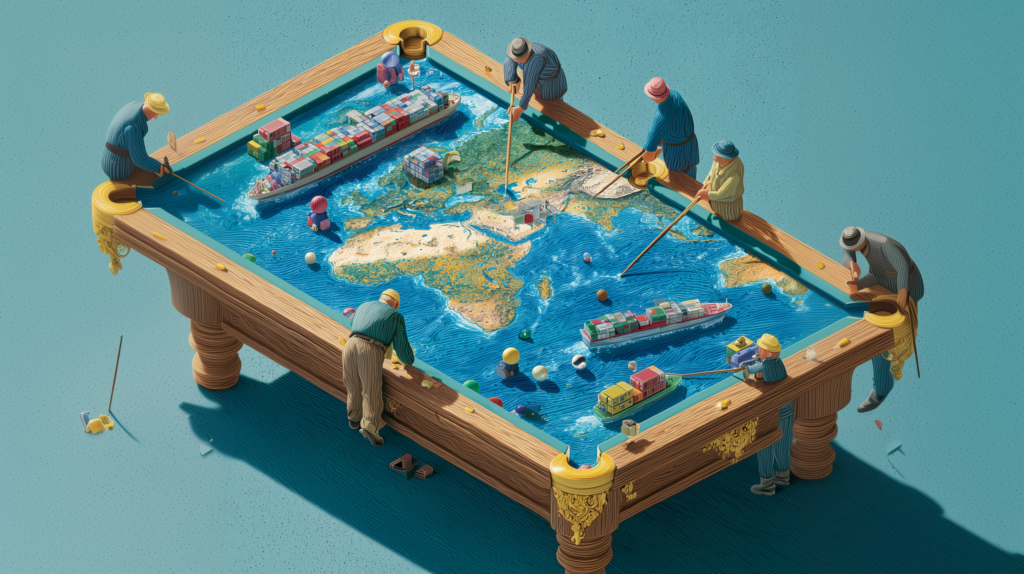
What Hormuz Reveals About the Supply Chain Resilience Matrix

A single disruption in a critical trade corridor can ripple across the global economy, revealing just how fragile and interconnected modern supply chains have become. Beneath the surface, hidden dependencies and concentrated routes amplify risk, forcing companies to confront an urgent question: how to build resilience in a world where the unexpected is no longer the exception.
The disruption of the Strait of Hormuz is often framed as a geopolitical crisis or an energy problem. In reality, it is far more revealing than that. It is a real‑time stress test of global supply chains, one that exposes not only who is exposed, but how deeply resilience was designed, or ignored, long before the first tanker was stopped.
Nearly a third of global oil and gas flows, alongside chemicals, fertilizers, aluminium, and refined products, transit through this narrow chokepoint. But Hormuz is not only an energy corridor. Its disruption rapidly spills over into manufacturing, aviation, global logistics, insurance, food processing, and consumer goods through higher input costs, longer lead times, and rising risk premiums. When such a corridor is constrained, the question is no longer whether companies will be affected. It is how differently their supply chains are structured to absorb the shock and adapt once cost, logistics, and uncertainty propagate far beyond commodities.
What matters now is not industry affiliation alone, but supply chain architecture. The Hormuz shock separates companies along two structural dimensions: their ability to absorb disruption and their capacity to adapt once buffers start to erode. Mapped together, these dimensions reveal four distinct strategic profiles – and four very different futures.
When Efficiency Becomes a Strategic Liability: from Resilience Champions to Shape-Shifters
Some firms enter this crisis as Resilience Champions. These organizations combine deep buffers with strong adaptive capacity. They hold strategic inventories, have financial slack, and control critical infrastructure, but they also possess the organizational muscles to reconfigure routes, renegotiate contracts, and reprioritize customers quickly. Companies such as Toyota, Apple, Unilever, or Maesk fall into this category. Their supply chains were never optimized solely for cost; they were designed with continuity in mind. For these firms, the Hormuz disruption hurts margins and efficiency, but it does not threaten survival. More importantly, it accelerates transformation. These companies do not aim to return to the pre‑crisis status quo. They redesign supply chains around new geopolitical realities, turning exposure into learning and crisis into strategic renewal.
At the opposite end of the spectrum stand Glass Houses. These firms lack both absorption and adaptation. Their supply chains were optimized for efficiency, not endurance, with minimal inventories, high energy or route dependency, and little financial slack. Fertilizers provide one of the clearest recent illustrations.
During the energy and logistics shocks of 2022–2024, major European fertilizer producers, including BASF, Grupa Azoty, CF Fertilisers UK, and Yara, were forced to curtail or suspend production as gas prices surged and input access collapsed. The 2026 Hormuz blockade extends the same lesson globally: Gulf producers such as QAFCO, Fertiglobe, or SABIC Agri-Nutrients run world‑class, low‑cost assets, yet remain highly vulnerable to disruptions in maritime access
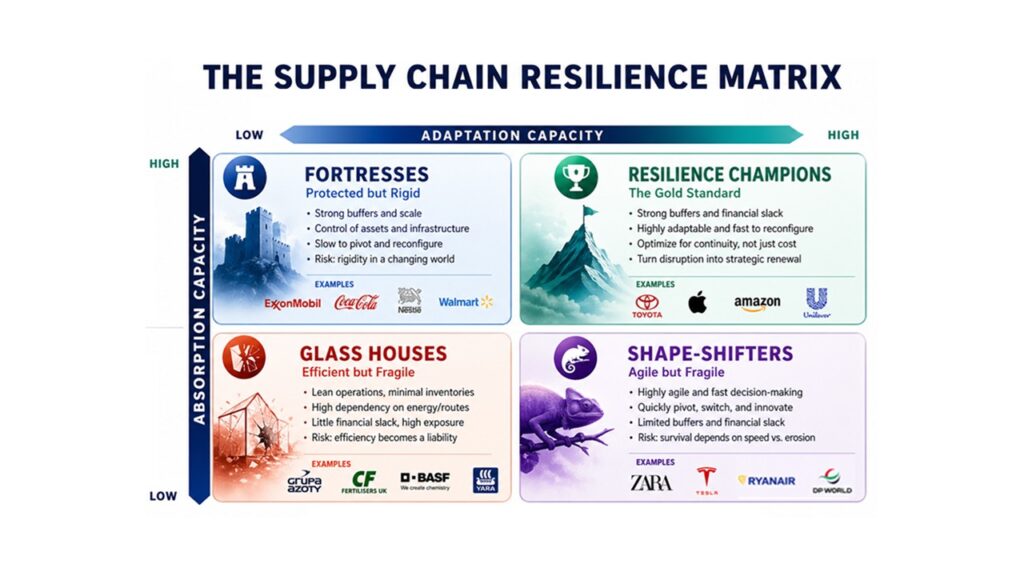
Fortresses are organizations with strong absorptive capacity but limited adaptability. Large incumbents such as ExxonMobil, Coca‑Cola, Nestlé, or Walmart illustrate this logic. They benefit from scale, infrastructure control, and stockpiles that allow them to continue operating while others stall. Hormuz does not stop them overnight. But it exposes a different risk: rigidity. Their size, complexity, and governance structures make rapid reconfiguration difficult. They absorb the shock, but struggle to pivot as trade routes, customer priorities, and geopolitics evolve. When the crisis moves from disruption to prolonged instability, Fortresses risk emerging misaligned with markets that have already moved on.
Read also: Microsoft’s Playbook for Thriving in Uncertainty
The final group is made of Shape‑Shifters. These companies are highly adaptive but structurally fragile. Zara, Tesla, RyanAir, or DP world can pivot quickly, switch suppliers, redesign offerings, and make bold decisions under pressure. Their organizations are flexible by design. But they lack deep buffers. When a disruption like Hormuz endures, agility alone becomes a gamble. Cash constraints, inventory shortages, or supplier failures can quickly overwhelm even the fastest organizations. Shape‑Shifters survive only if adaptation outpaces erosion. When it does, they reinvent themselves. When it doesn’t, speed becomes irrelevant.
The Strategic Lesson of Hormuz: Resilience Is Designed, Not Improvised
The Strait of Hormuz delivers an uncomfortable but clear lesson. Supply chain resilience is not an operational add‑on or a temporary crisis response. It is the outcome of long‑term design choices. Buffers without agility buy time, not relevance. Agility without buffers buys motion, not safety. Resilience lies in the balance.
Hormuz also shatters a managerial illusion: that firms can choose between efficiency and resilience. Resilience is no longer optional insurance. It is a competitive capability. Enduring firms are those that accepted some inefficiency yesterday to preserve strategic freedom today.
The key question for leaders is not exposure to this chokepoint, but which structural quadrant their supply chain is locked into. When the next chokepoint emerges, as it will, that answer will matter more than forecasts or contingency plans.
This crisis illustrates in real time what I develop in my latest book: resilience is built through the disciplined combination of anticipation, absorption, and adaptation. Hormuz is not an anomaly. It is the kind of event enduring firms plan for. They do it not because they can predict it, but because they have designed supply chains that can live through it and evolve beyond it.