Has AI Really Killed the Author?

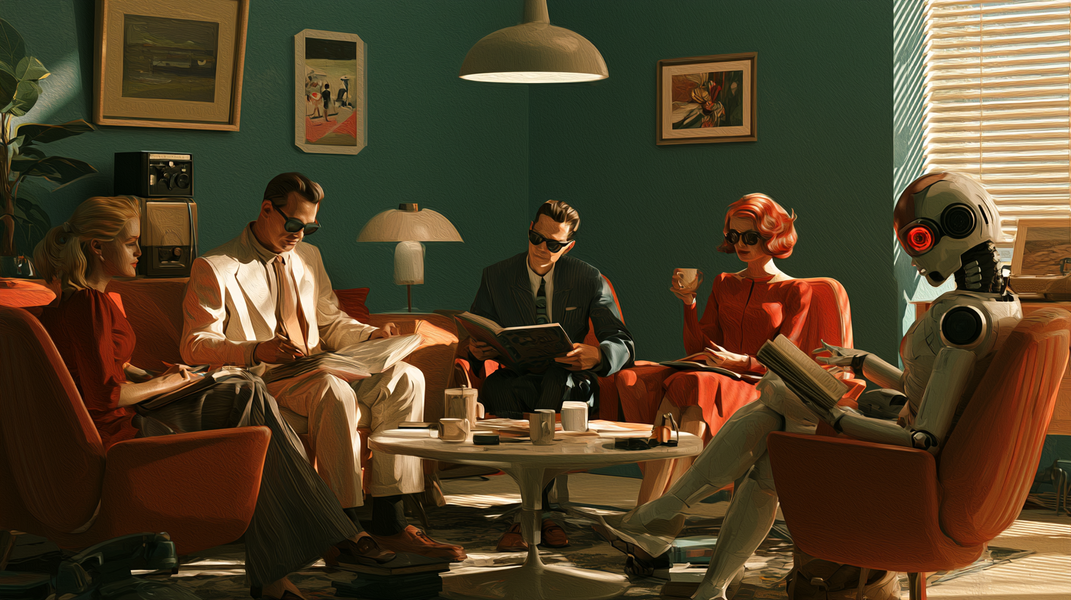
Roland Barthes did not wait for artificial intelligence (AI). More than fifty years before the emergence of ChatGPT, the French literary critic was already questioning the author’s sovereignty over their own text and its interpretation. But AI brings a new dimension to the debate – one Barthes could not have anticipated. Has AI joined the community of readers and definitively excluded the author from their own creation?
In 1967, the critic Roland Barthes published a short essay that would become famous: The Death of the Author. Barthes was not claiming that the writer literally ceased to exist. His idea was more provocative. He was challenging the author’s status as the ultimate authority over the meaning of a text. Neither the author’s biography nor their intentions can impose a single interpretation. Once published, the text escapes the “tyranny” of a single interpretation and opens itself up to multiple readings.
A Shift in Authority
The death of the author therefore represents a shift in authority: meaning is no longer imposed by a sovereign creative mind but rather produced collectively through the encounter between the text, its contexts and its readers. Each reader gives it a different meaning depending on their experience, culture and imagination.
In other words, the meaning of a story can never be reduced to its creator’s intentions. Some see this as a direct threat to creators: if AI can produce compelling stories, what is left of the author?
The Need for Stories and Interpretation
This question directly relates to my research on storytelling and persuasion. For several decades, I have studied how stories produce their impacts not only through what authors write, but also through the way audiences engage with and make these stories their own. In a documentary about the (human) need for stories, my co-authors and I showed that the same story never persuades everyone in the same way.
Two readers can experience the same story—whether told through a novel, a film, an image or a piece of audio—with different emotions and interpretations or even opposing values. We established that the power of a story arises precisely from this encounter between the text and the person receiving it.
Read Also: The More AI Thinks, the More Leadership Matters
Today, artificial intelligence is suddenly making this idea very concrete. Take Harry Potter. The novels have already been translated into dozens of languages, adapted into films, turned into video games, stage productions, attractions and countless works of fan fiction. As Umberto Eco describes it, each of these versions slightly alters the original work. Translators chose certain words over others. Directors cut scenes. Readers imagine sequels or relationships between characters that the author never considered. AI simply adds a new intermediary capable of producing an interpretation of its own.
When an AI writes a new Harry Potter adventure or translates a novel in a different style, it does not uncover the “true” text hidden beneath the surface. It produces a new reading, based on the millions of texts on which it has been trained and the instructions provided by the user. In this sense, artificial intelligence resembles a particularly sophisticated interpreter more than an autonomous author.
Artificial intelligence is blurring the boundaries between reading, interpretation and creation. Readers are no longer limited to interpreting a work: they can now ask an AI to continue it, transform it, change its point of view or imagine an alternative ending.
The Circulation of Meaning
But does this mean the author is disappearing? Not necessarily. Even if AI can imitate a style, it has no lived experience, nor artistic intention, nor moral responsibility. It recombines existing narrative forms based on vast collections of texts.
The use of copyrighted works to train models raises major copyright issues. Yet the fundamental choices remain deeply human: why tell this story, in what context, and with what values?
Perhaps the real change lies elsewhere. For a long time, we viewed the author as the sole source of meaning. Today, we are discovering that meaning circulates within a participatory culture among several interpretive communities: creators, translators, directors, fans, platforms… and now artificial intelligences. But can we really consider AI systems members of this collective in the same way as the rest?
A community is not simply a collection of accumulated works. It is more like a living organism: its members share, discuss and transform forms of expression because they inhabit a particular time, maintain relationships with one another and have a stake in what they express. A work of fan fiction, a translation or an adaptation says something about the person who produced it, but also about the world they live in, the values they stand for and the community they are addressing.
AI: a Super-Reader Outside the Collective
Artificial intelligence occupies a different position. As it has been trained on a volume of texts that no individual could ever read, it can give the impression of being a super-reader that has absorbed every possible version of a work. Yet it is not a collective brain. It is a statistical model built from traces left behind by human communities. It can recognise and combine their forms of expression, but it shares neither their history nor their concerns, nor does it feel any need to respond to them.
AI, then, is likely not killing the author a second time. Above all, it forces us to recognise that stories have always been collective works, constantly reinterpreted, rewritten and reappropriated. AI can now accelerate and disrupt this process without actually becoming a member of the collective.
Perhaps the author never really disappeared. Yet the author was probably never the sole creator.
This article is republished from The Conversation under a Creative Commons license. Read the original article.