Ulysses Bound to His Mast: The Law of The Freest

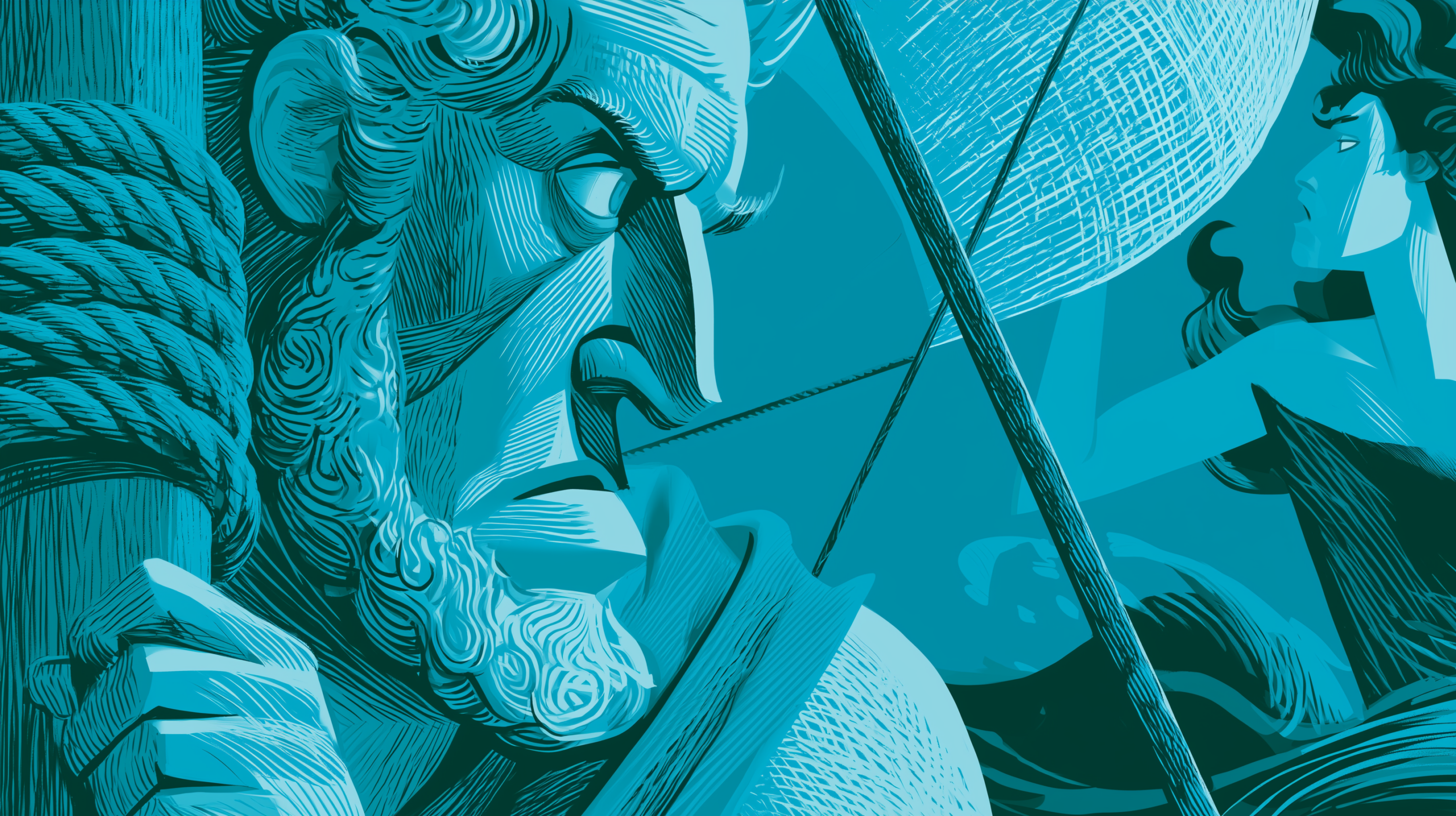
Free he who like Odysseus, he had himself tied to the mast? Bound to his ship to resist the Sirens, the hero of The Odyssey anticipates his own weakness and transforms a voluntary constraint into an instrument of freedom. In doing so, he foreshadows one of the fundamental principles upon which our legal systems are built.
You have never looked at Odysseus from this perspective. First, because, seventy years after Mario Camerini’s film starring Kirk Douglas, Christopher Nolan’s The Odyssey brings Homer’s epic to the screen with the scale and ambition of a global blockbuster. Second, because, without realizing it, you have already encountered – in Book XII of The Odyssey – perhaps the oldest description of the fundamental mechanism of law: a clear-headed man who binds himself today to avoid giving in tomorrow.
The scene unfolds in Book XII of The Odyssey. Warned by the enchantress Circe, Odysseus knows what lies ahead: the song of the Sirens, which no man can resist and which lures ships onto the rocks. But he knows something even more unsettling: he knows that he himself will want to give in. So he plans ahead. He has his companions plug their ears with wax, orders them to tie him to the mast, and gives them a paradoxical command: if I beg you to untie me, tighten the ropes instead.
Everything is decided before the first note is sung. As soon as the Sirens begin their song, Odysseus indeed pleads to be released. His sailors, deaf both to the song and to his cries, tighten his bonds. The ship sails safely past. Odysseus has heard what no one had ever heard without dying.
What is striking here is not the trick itself – Odysseus has many others – but the temporal structure of the decision. At time t, a clear-minded man accepts a limited inconvenience – being tied up, humiliated before his crew – to avoid, at time t+1, when his self-control has vanished, a far greater loss: shipwreck. He does not bet on his willpower. He bets on his own weakness and strategizes accordingly.
Jon Elster’s Imperfect Rationality
It is precisely this structure that the Norwegian philosopher and political scientist Jon Elster placed at the heart of his 1979 book Ulysses and the Sirens. His argument can be summed up in a single idea: we are not perfectly rational beings, but we are capable of recognizing our own irrationality and acting upon that knowledge. Elster calls this imperfect rationality.
A perfectly rational individual would not need ropes: he could listen to the Sirens and remain unmoved. An irrational individual would leap into the sea. Odysseus embodies a third possibility: someone who, unable to trust his future self, neutralizes it in advance.
The smoker who throws away his cigarettes, the saver who locks money into an inaccessible account, or the writer who disconnects from the Internet in order to finish a chapter all perform the same gesture, known in philosophy and economics as precommitment.
The calculation is economic in the strict sense of the term: incur a small and certain cost today to avoid a much greater and more likely cost tomorrow. The rope is an investment.
The Law Works in Exactly the Same Way
This is also how the law operates – not merely one particular area of law, but law itself insofar as it binds. Whenever a legal subject enters into a commitment, they repeat Odysseus’s gesture: they voluntarily restrict their future freedom because doing so serves their interests.
A contract is the clearest illustration. To sign a contract is to give up, in advance, the freedom to change one’s mind. Whoever undertakes to deliver goods, make a payment, or refrain from competing ties themselves to the mast. The binding force of contract plays the role of the deaf sailors, enforcing the commitment even against the later pleas of the person who signed it. Without this rope, no promise would be credible, and no exchange extending over time would be possible.
Read also: Avatar: From Earth to Pandora, What Rights do we Have Over our Environment?
States reason in much the same way. When a state ratifies a treaty – such as the Montreux Convention regarding the Straits or the United Nations Convention on the Law of the Sea – it voluntarily relinquishes future room for maneuver precisely because it knows the temptation to reclaim that freedom will eventually arise. A rigid constitution follows the same logic. By making constitutional amendment deliberately difficult, constitution-makers protect fundamental principles against the passions of future political majorities.
Sometimes, the task of holding the rope is entrusted to a third party. A constitutional court empowered to strike down legislation or an independent central bank tasked with resisting demands for easy money both serve as institutional crews whose very purpose is to remain deaf to the captain’s later pleas. Their independence is not a democratic anomaly; it is the wax in their ears.
Some legal systems go even further. Germany’s Basic Law contains an “eternity clause”, which places human dignity and the core principles of the rule of law beyond the reach of amendment. Here, the state has not only bound itself – it has made itself permanently deaf to any future attempt to undo its own commitments.
Elster’s Qualification – and the Law’s Response
Intellectual honesty requires acknowledging that Elster himself eventually questioned his own metaphor. In Ulysses Unbound (2000), he points to a crucial difference: Odysseus binds only himself, whereas a constituent assembly primarily binds future generations, who never agreed to the arrangement. What appears to be self-restraint therefore becomes, from the perspective of the living, a constraint imposed by the dead.
The objection is a serious one. Yet the law answers it with one of its most familiar fictions: the continuity of the state.
It is because France in 2026 is legally regarded as the same juridical person as France in 1958 – or the France that signed the Montreux Convention in 1936 – that its commitments remain binding despite changes of government and the passage of generations. The analogy with Odysseus is imperfect. Yet it is precisely through that imperfection that it proves illuminating. Law rests on the assumption that a collective “we” endures over time and is capable of making promises to itself.
Odysseus Wanted to Listen
One final point deserves attention. Read the episode again: Odysseus could have plugged his own ears with wax, just as his sailors did. He chose not to.
His calculation was not merely defensive. It was a way of enjoying the Sirens’ song without dying – a strategy for experiencing danger without paying its ultimate price.
The law serves a similar purpose. It does not merely protect us from our passions; it allows us to approach them safely. Marine insurance was not created to prevent people from going to sea, but to make them willing to sail. Contracts do not exist to restrict exchange; they make exchange between strangers possible.
The rope is not the opposite of adventure. It is what makes adventure possible.
Perhaps that is what audiences will take away from Nolan’s film. The hero of a thousand stratagems was never freer than when he was tied to his mast.
This article is republished from The Conversation under a Creative Commons license. Read the original article.