Turnaround Is Not About Survival: It Is About Renewal


In today’s volatile business environment, corporate turnaround is often seen as a last-ditch effort to avoid collapse. The example of IBM CEO Arvind Krishna shows that turnaround is not about mere survival – it’s about renewal. This mechanism is a strategic reset: it’s the opportunity to restore discipline, redefine competitive relevance and revitalize organizational culture. Far from being defensive, a successful turnaround become a catalyst for long-term transformation and sustainable growth.
The timeless principles behind effective turnarounds
In the new edition of my book The Timeless Principles of Successful Strategy, I argue that turning around a company is often indispensable if it is to endure.
This conviction was recently reinforced by a compelling interview with IBM CEO Arvind Krishna in McKinsey Quarterly, where he describes how he led IBM through a profound renewal during a time of uncertainty. His account illustrates, with striking clarity, the strategic and cultural dynamics that define a successful corporate turnaround.
Turnarounds are frequently misunderstood. They are often portrayed as dramatic rescue missions, moments of corporate pain, uncertainty, and austerity. Yet a turnaround is not simply a defensive response to crisis. It is a strategic inflection point: a rare moment when a firm can not only restore viability, but reimagine what it could become.
In enduring organizations, a turnaround is not the end of something. It is the beginning of renewal.
Today, as many firms confront volatile markets, rising costs, technological disruption, and cultural fatigue, the capacity to turn around an organization with both discipline and imagination is more essential than ever.
In my book, I describe how successful turnarounds tend to follow a three-stage movement:
- Recovering discipline
- Rediscovering relevance
- Reinvigorating the organization
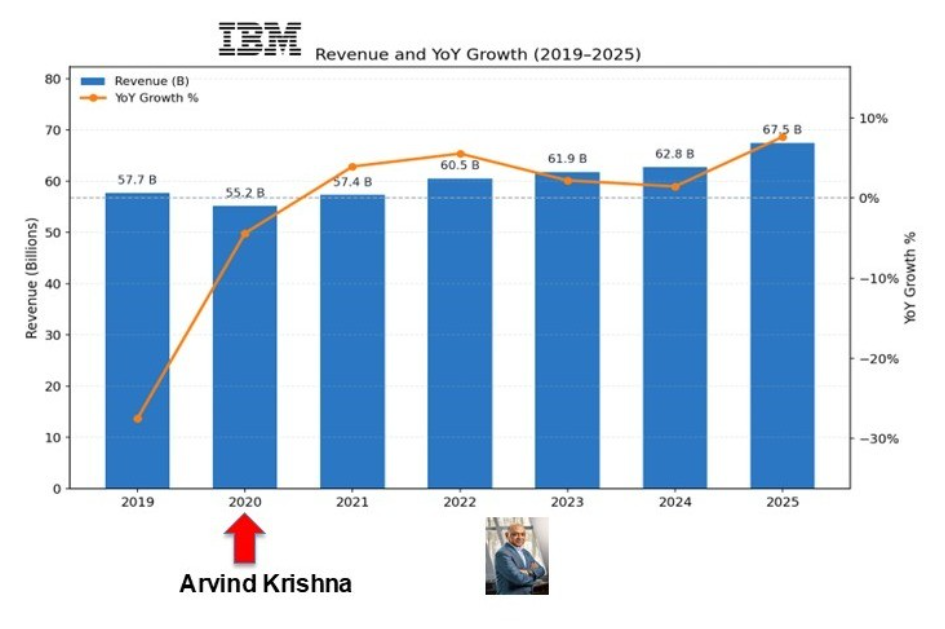
This architecture is not theoretical. It can be observed in some of the most significant transformations of our time. A striking illustration is IBM’s renewal under Arvind Krishna, whose actions since becoming CEO in 2020 mirror, almost point by point, the logic of this journey.
Why turnaround matters for enduring firms
Enduring companies do not survive by avoiding crisis. They survive because they learn how to respond to crisis in ways that restore vitality and unlock new strategic pathways.
A true turnaround is not merely a contraction. It is a process of rediscovering what the organization truly stands for and repositioning it for future relevance.Turnaround is not about “saving what is left.” It is about identifying what is worthy, removing what is not, and rebuilding the future from a cleaner, sharper foundation.
Read also: Entre mode et beauté, les marques de luxe face au défi de la cohérence
Throughout history, enduring firms have shown resilience not because they predict the future better than others, but because they possess the humility and courage to repair themselves, often before the environment forces them to.
When markets shift fast, complacency is fatal. The firms that navigate uncertainty best are those that act with purpose even when clarity is incomplete.
Recovering Discipline: Decreasing Costs with Purpose
The first movement in a turnaround is the restoration of discipline.
Periods of prosperity inevitably produce excess: layers of bureaucracy, redundant processes, and strategic “pet projects” that quietly drain energy and resources.
In enduring organizations, cost reduction is not an act of desperation. It is an act of clarification.
This typically involves:
- Simplifying structures, not just cutting budgets
- Reducing fixed obligations while preserving flexibility
- Digitizing processes to convert overhead into scalability
- Reviewing variable costs for efficiency and not indiscriminate cuts
- Eliminating activities that no longer express the firm’s strategic identity
This disciplined retrenchment is the equivalent of clearing the deck before the next voyage.
IBM as illustration :
When Arvind Krishna became CEO, he inherited a company burdened by complexity and stagnation. Rather than pursue incremental adjustments, he initiated a structural reset.
IBM divested businesses that no longer aligned with its long-term technological path, removing roughly a third of the company’s revenue and employee base. Not to shrink IBM, but to sharpen it.
This is cost discipline as strategic renewal.
Redisccovering Relevance: Improving Revenues with Meaning
Once discipline is restored, the second movement turns outward.
A turnaround succeeds not because a company cuts well, but because it rediscovers its relevance, its unique value in a changing world.
Reviving revenues with meaning requires:
- Deep reconnection with evolving customer needs
- Reinterpretation of the firm’s identity
- Concentration on markets where the company can lead, not merely participate
- Innovation that reinforces strategic distinctiveness
- Rebuilding trust through consistent performance and clarity of purpose
Enduring firms do not chase growth for growth’s sake. They choose growth that strengthens who they are.
IBM as illustration:
Krishna concentrated IBM on innovation-driven segments such as software, hybrid cloud, AI, and quantum computing. Software grew from 22% to 45% of IBM’s business under his leadership.
He also articulated a principle I emphasize in the book: the best acquisitions are those that accelerate organic growth by sharpening identity. As he put it, IBM would “never buy something unless it helps organic growth go up.”
IBM’s renewal was not a return to the past. It was a recalibration toward a future IBM was uniquely positioned to own.
Reinvigorating the Organization: Renewing People, Culture, and Confidence
No turnaround endures unless the organization regains its energy, cohesion, and confidence.A renewed cost base and a clearer strategy remain fragile without a cultural shift that rebuilds trust and reawakens ambition. This third movement requires:
- Clarity of purpose
- Visible and transparent leadership
- Symbolic acts that reinforce accountability and pride
- Empowered teams supported, not obstructed, by leadership
- Norms that reward speed, responsibility, and learning
Turnaround is as emotional as it is economic. People must feel that the organization has a future and that they have a place within it.
IBM as illustration:
Krishna has been explicit that culture, not strategy, became the decisive lever of IBM’s transformation. He argues that leaders should spend roughly 50% of their time on talent and culture.
He reshaped IBM’s leadership model by combining external hires with internal talent promoted several layers up, creating both fresh perspective and continuity.
He also fostered constructive risk-taking. When a team proposed a 21-month timeline to develop a new AI modernization tool, he challenged them to deliver in six months and provided the resources to make it happen.
Inside IBM, this story became symbolic of what was now possible.
This is what I call rational audacity: urgency with clarity, courage with discipline, and ambition grounded in purpose.
The Strategic Essence of a Turnaround
A successful turnaround is not a temporary correction. It is a strategic rebirth.
Enduring firms navigate it through three disciplined movements:
- Recovering Discipline
- Rediscovering Relevance
- Reinvigorating the Organization
IBM’s renewal reminds us that even century-old organizations can regain vitality when they act with courage and clarity.
Turnaround is not about returning to what a company once was. It is about becoming what it must be to endure.